The Chinese anthropologist Xiang Biao talked about something he called “the nearby” in a 2019 interview. The idea set off a wave of discussion on the Chinese internet, and it has come up again and again since.
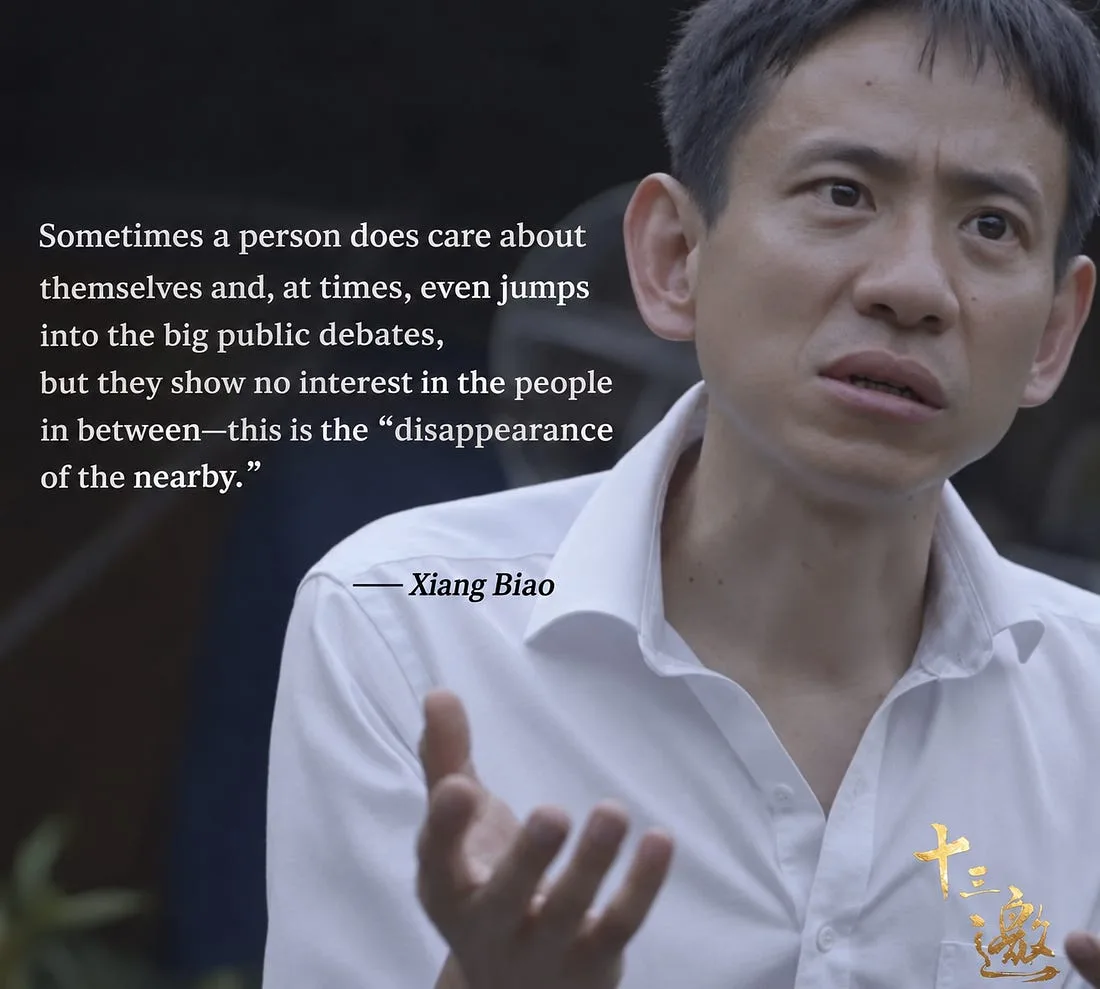
By the nearby, Xiang means the people and places you deal with in daily life: your neighbors, your street, the people whose work keeps your day running. He argues that for many young people this layer of life is disappearing, partly because of what he calls “the tyranny of time”: our days are run by schedules and deadlines, and the places and people we pass on the way stop registering. We also increasingly make sense of the world through abstract ideas, and less through what is in front of us.
The missing middle
Young people pay close attention to their own lives and the few people closest to them: exams, careers, what their parents expect. This part of life feels very close and very heavy.
They also see the wider world every day through their phones: wars, disasters, political crises in places they may never visit. They can’t do much about any of it.
What gets lost is the part in between. Xiang says that people’s sense of what life around them is actually like has become vague. Neighbors, street cleaners and market vendors keep daily life going, he says, yet “we often look straight through them.”
A simple test: do you know who lives directly above you, or who drives the bus you take to work?
This middle layer is where large problems turn into specific ones. A housing crisis shows up as your landlord raising the rent. A labor dispute shows up as your bus not running. When you lose sight of that layer, the only things left are your own life and a world you can’t reach.
Emotional bombs
News from far away usually reaches us in a form designed to provoke a reaction. A crisis is cut down to its most painful fifteen seconds and placed in the feed between a recipe and a friend’s engagement photos. A few seconds later it is replaced by the next one.
I think of these as emotional bombs. The events themselves are real, and many deserve more attention than they get. They reach us with a strong feeling attached and nothing we can do with it. After a night of this, you are less steady than before.
Xiang draws a line between approval and recognition. Approval, he says, “is a one-way street,” like a like or a share. Recognition is “a matter of reciprocal understanding” and needs people who can see each other. Social media mostly offers approval. You can share a cause or donate to it, and no one involved will ever know who you are.
He also describes the modern world as “transparent yet impermeable.” We can see a great deal of what happens in the world, and we can take part in very little of it.
Free-floating anger
Anger usually points at a cause. It is most useful when the cause is something you can deal with, like a landlord who won’t fix the heating.
When the middle layer disappears, anger loses those targets. It attaches instead to very large things, such as “the system” or “capitalism.” These forces are real, but there is no one to talk to about them and nowhere to go.
In Xiang’s words, we now build our picture of the world “through abstract concepts and principles.”
The British critic Mark Fisher called the result “reflexive impotence.” He noticed that his students knew things were bad and also believed they couldn’t do anything about it, and that belief made it true.
Xiang has another concept, suspension, for the way many young people live: they move often and work very hard “to benefit from the present as much as possible,” while treating the present as a temporary stage. If you expect to leave the city where you rent in a year or two, there seems to be little reason to learn your neighbor’s name or go to a tenants’ meeting.
So the anger stays where it is. We know something is wrong, and we can’t find a part of the problem we are able to touch.
Weekend Dread
Xiang mentions a feeling many young Chinese call “weekend dread”: anxiety on a Saturday with nothing scheduled, when work stops and there is nothing nearby to turn to.
We still live in physical places, and for many young people those places are getting harder to live in, with higher rents, longer commutes and less secure jobs. The pressure is there every day, but there is no one around to share it with. You can be angry, or in trouble, and nobody on your street knows.
The nearby is how private feelings reach other people. A complaint about the heating becomes a conversation in the stairwell, then a letter signed by several neighbors, and eventually a repair. This kind of change depends on people who know each other a little and share a place.
He also describes what this does to a person. “If everyone is a stranger to you,” he writes, “then you are a stranger to everyone and also a stranger to yourself.” Part of who we are comes from being known by the people around us, such as the man at the coffee counter or the neighbor upstairs. Without them, the people who see us most are our employers and our families, and neither sees all of us.
The neighbor you can’t move away from
It would be easy to turn this into advice about building a warm community. Xiang warns against treating the nearby as a circle of like-minded people you put together for yourself. In one interview he puts it more bluntly: the nearby is the neighbor you can’t stand but can’t move away from.
I think it is right. Most of our relationships are now chosen, from the accounts we follow to the people we date. The people nearby are the ones we didn’t choose, like the neighbor who always parks badly. You don’t have to like them, but they share your building and your street, so they are the people you could actually change something with.
I’m less sure of that now. A lot of what wore the nearby away came from specific decisions. Housing was built as gated compounds with a guard at the entrance and little shared space inside. Delivery apps made leaving food at the door the default. Rents kept rising until moving every year or two became normal, and many jobs now expect an answer at any hour. Each of these made sense to someone, and together they left very little room for the people around us.
If these were decisions, they can be questioned, and some of them may be worth resisting. I don’t know what that looks like at the scale of a city. For one person it might mean staying in a neighborhood longer than is convenient, going into the shop instead of ordering, or turning up to the meeting about the building even when it’s dull. All of this costs time, which is the thing Xiang says we have learned to guard most closely.
I keep wondering what a city built to keep the nearby would look like, and whether we would be willing to live a little more slowly to have it.