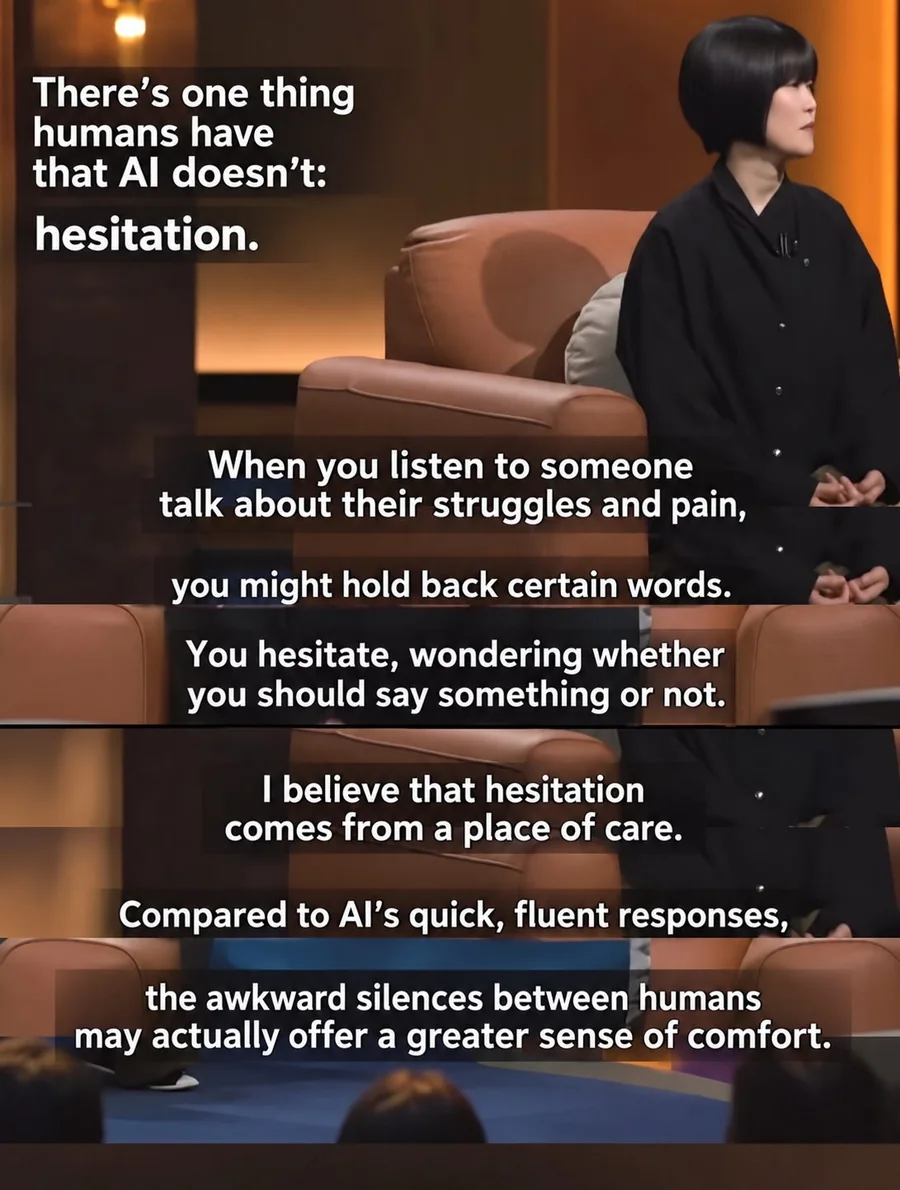
The Korean novelist Kim Ae-ran once said that what humans have and AI doesn’t is hesitation. When we listen to someone tell us about their troubles and their pain, we waver, we wonder what they need to hear, and sometimes we’ve already decided what to say, only for the words to reach the tip of our tongue and get swallowed back down. She believes that inside these hesitations live understanding, care, and dignity, and that a person’s clumsy silence can sometimes comfort more than all the fluent advice an AI could give.
Blank space often carries a density of meaning that goes beyond words. It is the part of a conversation that doesn’t get filled in, the pause after someone finishes speaking, the answer that doesn’t come right away, and it is rarely as empty as it looks. Between two people, that blank space is often a face-to-face silence, a moment where nothing is said while someone’s eyes, the way they breathe, how close they sit, and the sounds and light of the place around you all keep speaking. Words can only carry what we manage to name, and a silence leaves room for everything we can’t.
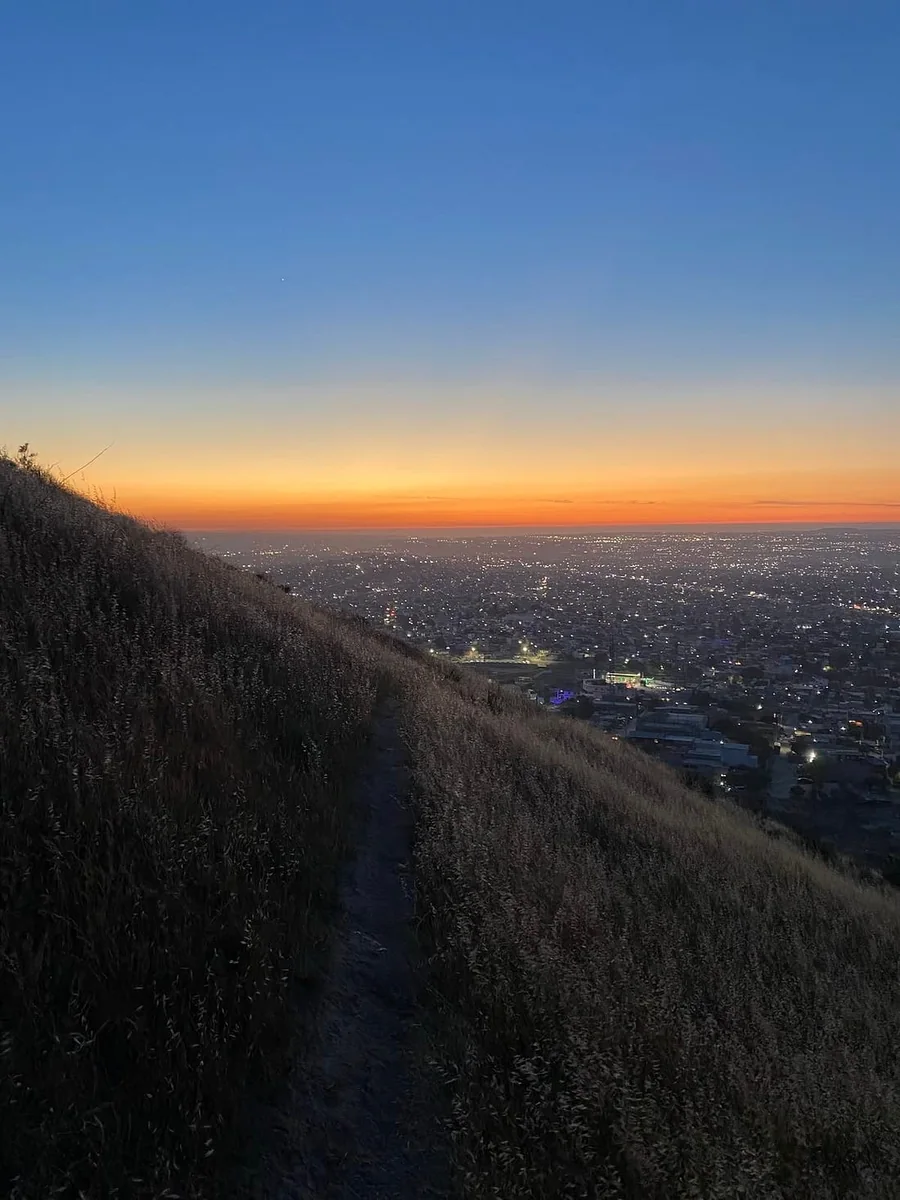
When I think of that kind of blank space, I think of a night when a friend and I walked up a small hill. It was that hour when day and night meet, when the last red glow along the horizon runs for a moment into the deep blue of the evening, and below us the city was scattered with little lights.
The early autumn breeze carried the smell of grass and trees from the hillside, and I said the wind felt so nice tonight. My friend just looked quietly down at the city. In that moment the only sounds were the wind and a few birds, and I felt our hearts were completely in tune, and the sky and the earth we were feeling together became the language of that moment. A silence like that, held up by the small details of the body, the air, and the light, can turn into a kind of forever, staying with you long after you’ve forgotten what anyone said that night.
Or maybe sometimes a silence isn’t anything so meaningful. Maybe a person just doesn’t know what to say, and the silence is nothing more than a small human glitch, a mind that froze for a second. I think even that has its own tenderness, because at least it belongs to someone.
In this fast-paced era, this kind of silence has become something people can’t stand and can’t be bothered to read. Everything now comes to us direct, just as we expect AI to give us the fastest, most accurate answer. A pause in a conversation feels like dead air we rush to fill. AI can’t truly imitate this silence, but we humans are slowly losing the patience to read it.
The hesitation Kim describes made me realize that the way people respond to each other can’t always be measured by whether an answer was given. Sometimes we just want to know that the person sitting across from us has truly taken our situation to heart. When we use AI, we naturally want it to be a little faster, a little more accurate, and ideally to get straight to the point, and when we’re getting things done, that kind of efficiency is great. But when it comes to how people treat one another, the responses that aren’t so quick and clean can matter a great deal, because the hesitation Kim talks about happens right after we’ve heard someone else’s pain.
I’ve also come to realize that talking with real people in real life carries a strong flow of energy.
You know that behind the words on the surface there is a soul shaped by many years of living, flesh and blood fighting their way through the world just like you. When two people’s experiences and ideas run into each other, thoughts start to shift and resolve starts to form, and that can change a great deal. That is something you can’t get from talking to AI.
We can keep using AI and still remember that some questions are better asked out loud, to someone who might hesitate before answering.
The next time you want to know how your grandmother made that soup, you could call her instead of looking up a recipe, and listen to her forget one step and remember another along the way. When something in your home breaks, you could knock on a neighbor’s door. When you’re stuck on a decision, you could ask the friend who has been through it already, and let them take their time. These are small things, and they won’t fix much on their own, even as the electricity flowing into the world’s data centers keeps climbing year after year. But each one is a chance to practice the patience we’re losing, to sit through a pause with someone and notice what lives inside it.
Human language has a power that goes straight to the heart, and truth and sincerity are in themselves an irreplaceable force, one that can empower the people around us. Maybe that force lives as much in what goes unsaid as in what we say, in the silence across the table, the words someone swallowed because they were afraid of hurting you, the long pause before they finally said they were here. AI doesn’t hesitate, and maybe it never will, but we still can, as long as we haven’t forgotten how to wait for each other.