Yesterday I was listening to a podcast episode built around a simple question: has AI actually made the world better? On the show, the guest Li Zhilin brought up a line from Demis Hassabis, co-founder of Google DeepMind: if you stop and really think about it, we have essentially found a way to make sand think.
It's a beautiful sentence. The main ingredient in a computer chip is silicon. Silicon can be extracted from quartz sand. We dig up sand, refine the silicon out of it, etch it into chips, run electricity through them, and something that looks like intelligence emerges. It does sound close to a miracle.
But Li has spent years working in the nonprofit world, and when he read that line, the first thing he thought of was that quartz dust is also the main cause of silicosis, one of the deadliest occupational diseases on earth. Every link in the chain that teaches sand to think: quarrying quartz, digging the coal that generates the electricity, or refining rare earth metals, may involve someone breathing in dust. He said he couldn't think of a crueler or more accurate metaphor for our time.
The same substance, at one end of the supply chain, is purified into the chips behind the most exciting technology of the age. At the other end, it may come to rest as dust in the lungs of miners and workers.
Two kinds of quartz
Silicosis is an old disease, and what it does to the body cannot be undone.
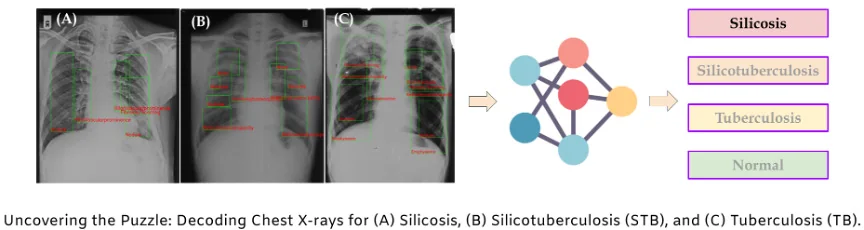
California's Department of Public Health recently published a report on a single occupation in a single American state: the people who cut and polish engineered-stone kitchen countertops. These slabs are sold, quite literally, as "quartz." They can contain 90% crystalline silica or more, far higher than natural granite or marble. Between January 2019 and June 2026, the state identified 592 cases of silicosis among these workers. Thirty-one had died. 65 had needed lung transplants. The median age at diagnosis was 46.
An earlier study of the first 52 California cases found that 51 were Latino immigrant men, more than half were uninsured or underinsured, and nearly half kept cutting stone after they were diagnosed. In 2024, Australia became the first country in the world to ban engineered stone outright, after its regulators concluded there was no safe level of silica in the product and found that stone workers were being diagnosed much younger than workers in other industries, most of them under 35.
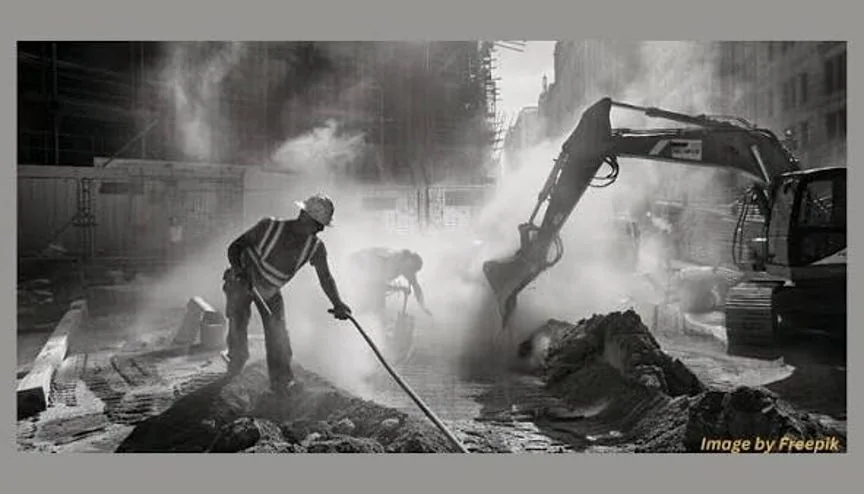
So the dust isn't only in some faraway mine. It is in workshops a short drive from the showrooms where people choose the finish for a new kitchen island. The sand that thinks and the sand that kills come from the same mineral. Sometimes they are even sold under the same name.
What clouds are made of
A chip is a small, clean, almost weightless thing. The buildings full of servers that run the models are called "the cloud," a word that makes vast infrastructure sound light and pure.
Every droplet in a real cloud forms around a speck of something solid: a crystal of sea salt, a fleck of soot, a grain of mineral dust lifted off a desert. Meteorologists call these specks cloud condensation nuclei, and without them the sky would struggle to make clouds at all. The softest, lightest thing we can see from the ground is built, at its core, on dust.
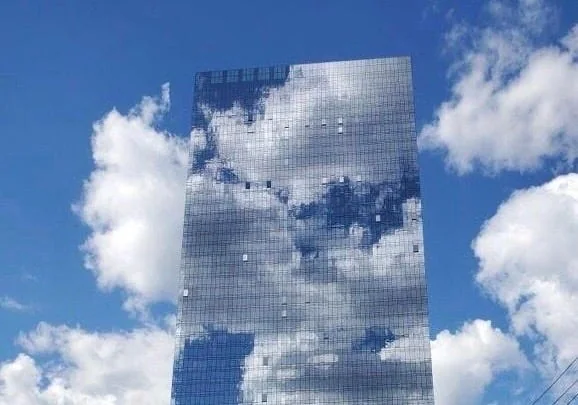
The other cloud works the same way. Behind every answer a chatbot gives are data centers drawing power from the grid, chips etched from refined silicon, and, further back, quarries, mines and workshops where the air is thick with particles no one will ever see on a screen. The cloud looks as if it floats. It condenses around dust.
Whose world got better
Which brings us back to the podcast's question. Has AI made the world better?
AI systems have already done remarkable things. AlphaFold, the DeepMind model that predicts the shapes of proteins, earned Hassabis a share of the 2024 Nobel Prize in Chemistry, and researchers around the world now use it in work on drugs and disease. Writing about AI's costs while pretending its benefits are imaginary would be its own kind of dishonesty.
But "better" always comes with a frame. The question quietly assumes one world and one ledger, when in practice the gains and the costs often land on different people, in different places, who will never meet. The prosperity was real, and so was the cruelty, and for a long time only one of them made it into the story the country told about itself. Most eras' miracles have had a part that was left out of the picture.
The man cutting a quartz slab in a dusty workshop in Los Angeles, or digging coal in a mine in northern China, is rarely in the room when we argue about whether AI is good for humanity. He doesn't appear in the product demo. His lungs are not part of any benchmark. The story of a miracle simply has no place to put him.
Our care has to grow as fast as our machines
I'm not arguing that we should stop building AI, or feel guilty every time we open a chatbot. Guilt is mostly useless; it tends to make people look away faster. What Li's metaphor asks for is something smaller and harder: that we keep both ends of the chain in the same sentence.
Sand that thinks, and sand that settles in someone's lungs. A model that can predict how proteins fold, and a man in his forties waiting for a lung transplant.
In practice, that might mean asking where the materials in our devices come from. It might mean supporting the slow, unglamorous work of occupational health: the respirators, the water fed onto saw blades to keep dust down, bans like Australia's, the clinics that screen miners' lungs. And it might mean noticing when a story about progress has no people in it, and asking who was left out. For those of us who tell that story, the founders, the commentators, the people who write essays like this one, it means making a habit of telling it whole.
We taught sand to think. It is one of the most astonishing things our species has done.
AI's capabilities will keep growing. Every year the models will reason further and take on more of what we once believed only people could do. I hope our capacity to care about people can keep up.
The more we teach sand to do, the more clearly we should see the people who dig it, cut it, and breathe it.